The Candlelight Motif of Winter Night
Doctor ZhivagoThe candle motif in “Winter Night” turns a small flame glimpsed in a window into a hinge between memory, love, poetry, and death. Its repeated appearance in Yurii Andreievich Zhivago’s poem recalls the candle that Larisa Antipova remembers burning on her window sill, and his sight of that light from the street is later imagined as the beginning of the course that would lead to his death. The image therefore does more than describe winter: it connects a private scene to the shape of a life, and a poem to the moment of farewell.
The poem’s recurring flame
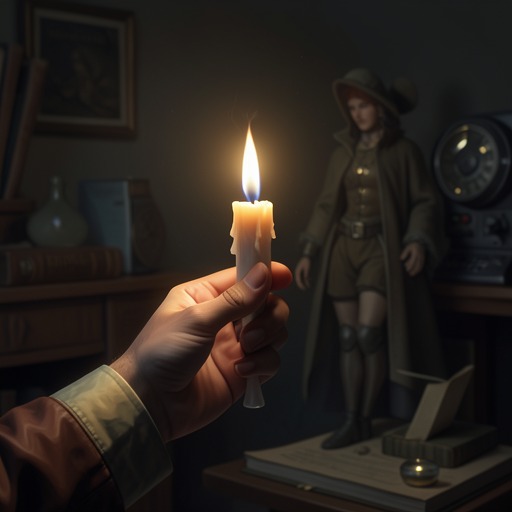
“Winter Night” places the candle inside an encompassing snowfall. The opening lines describe snow falling across the whole world and sweeping it from end to end; against this vast, enveloping whiteness, the poem repeats, “A candle burned on the table; / A candle burned.” The plain statement returns as a refrain, giving the flame a persistence that the blizzard’s scale and motion seem to threaten.
The refrain recurs as the poem moves through distinct images of winter. Snow and the blizzard sculpt arrows and whorls on the glass; distorted shadows fall; the world disappears into snowy murk. Each time, the candle is named again. The repetitions do not remove the surrounding darkness or storm. Rather, they keep the light present within it, so that the poem’s movement alternates between engulfment and return: the world vanishes from sight, and the candle remains as the image the poem can recover.
The recurrence also makes the candle a structural link rather than a decorative detail. The scene at the window, the weather outside, and the changing shadows belong to one winter setting, but the repeated line gathers them around the flame. When the poem specifies that snow fell hard throughout February and almost constantly, the refrain persists within that extended season. Winter’s duration becomes the condition against which the brief, steady image is recognized.
A remembered window and a life’s turning point
The poem’s later significance comes into view at Yurii’s funeral. Larisa remembers that, at Christmastime, she had set out to shoot a caricature of vulgarity and spoke in that very room, lit only by a candle, with Pavel, who was still a boy. Yurii had not yet entered her life. Of the conversation itself, her memory preserves almost nothing: what remains is the candle burning on the window sill and melting a round patch in the icy crust on the glass.
The remembered candle joins the poem’s image to a particular place and circumstance. It is not only a flame against winter but a light at a window, surrounded by frozen glass and recalled at the moment when Larisa faces Yurii’s dead body. The detail of the round patch makes the window scene intimate and bounded: a small opening in the ice, with the candle’s presence registered in the surface around it. What persists in Larisa’s memory is less the talk than this visual trace.
The narration then asks whether Larisa could have divined that Yurii, riding past, had seen the candle. It connects that sighting to the words “A candle burned on the table, a candle burned ...” and imagines that, from the instant he noticed its light in the street, his life took its fatal course. This is framed as a possibility, not as a demonstrated causal explanation. Its force lies in retrospective pattern: a moment that was ordinary and unnoticed by Larisa becomes, after Yurii’s death, a possible beginning whose meaning the poem has preserved.
Poetry, memory, and separation
The candle’s return also reveals how the poem carries an experience beyond the living scene. By the time Larisa remembers the window, the candle is attached to a past encounter she can scarcely reconstruct, while the refrain gives the image a form capable of returning. The poem does not restore the lost conversation or undo the separation between the living and the dead. It makes the remembered light available again, with the repetition itself marking both endurance and distance.
The motif thus links private experience to artistic work without collapsing them into one another. The remembered candle belongs to Larisa’s room and to a winter night; in the poem it becomes a refrain amid snow, glass, shadows, and darkness. At the funeral, that refrain allows the narrative to recognize a possible connection between the scene Larisa recalls and the course Yurii’s life took. The connection remains imaginative and retrospective, but its ambiguity is essential: the poem gives shape to the significance of the light without claiming that the characters understood its significance at the time.
Narrative significance
The candle motif binds together moments separated by years and by radically changed circumstances: a window scene before Yurii’s relationship with Larisa had begun, the poem’s winter landscape, and Larisa’s encounter with his body at his funeral. Its repeated wording carries the image across those gaps, while the framing at the funeral changes how the earlier scene can be read. What once marked a patch of warmth in an icy window is now recalled as a possible point of departure for a fatal life story.
The motif’s power depends on the contrast between scale and duration. Snow spreads across the world and nearly erases it; the candle occupies a table or window and burns within the storm. The poem does not make the flame triumph over winter. Instead, it makes the small light recur, and the narrative makes that recurrence bear the weight of memory. In this way, the candle becomes the poem’s link between an isolated instant and a life understood only after loss.